
About the program
The Office of Faculty Affairs collaborates with the Duke Office of DKU Relations (DODR) to support Duke-DKU Faculty Mentoring Program, which is initiated to provide guidance by a group of senior Duke faculty to tenure-track junior DKU faculty as they prepare for their tenure review. As a young liberal arts and sciences university, DKU has a predominantly junior faculty and a unique academic environment that blends strong teaching focus, interdisciplinary curricula, and evolving research infrastructure.
In the program, Duke mentors meet with mentees monthly and they are invited for an in-person visit to DKU every year and participate in activities open to DKU faculty more broadly, such as panel discussions on APT and IDS. This program addresses the limited internal mentoring capacity and offers DKU faculty expert guidance as they navigate the tenure and promotion process.
The program was first launched in 2024. During the initial two rounds, 42 DKU assistant professors from various disciplines participated, representing the majority of eligible faculty. For each round, assistant professors approaching their tenure review are identified by their unit heads and receive a separate invitation from the Office of Faculty Affairs regarding program participation. In AY26/27, 29 DKU assistant professors are currently enrolled in the program.
Mentors will give:
- Advice on research progress and strategy towards tenure, e.g. writing IDS, optimizing time allocation between scholarship, teaching, and service.
- Advice on research agenda and career development, e.g. grant applications, building collaborations, development of research projects.
- Advice and feedback on publications, e.g. on mentees’ manuscripts and proposed publication venues, guidance on the book publishing process.
- Advice on building connections with Duke, e.g. with departments and institutes, opportunities for joint work, graduate student co-supervision.
AY 26/27 Duke Mentors
 Dirk Bonker, Associate Professor of History, Trinity College of Arts & Sciences, Duke University
Prof Bonker is a historian of the United States and Germany, who focuses on questions of militarism, warfare, and empire in the long twentieth century. In his work, he also addresses larger questions about how best to “globalize” and “internationalize” U.S and German histories in the modern age.
Kate Bundorf , J. Alexander McMahon Distinguished Professor of Health Policy and Management, Sanford School of Public Policy, Duke University
Prof Bundorf’s research focuses on health policy and the economics of health care systems. She has studied public and private health insurance markets, the organization of health care providers, and consumer decision making in health care. Prior to joining the faculty at Duke, Prof Bundorf was an associate professor of health research and policy at the Stanford University School of Medicine. She is also a faculty research fellow at the National Bureau of Economic Research. Prof Bundorf received her MBA and MPH from The University of California at Berkeley and her PhD from The Wharton School. She was a Fulbright Lecturer at Fudan School of Public Health in Shanghai, China during 2009 and 2010. Her research has been published in leading economic and health policy journals and has received funding from the U.S. National Institutes of Health, the Agency for Health Care Research and Quality, and the Robert Wood Johnson Foundation. She received the 13th Annual Health Care Research Award from The National Institute for Health Care Management in 2007.
 Shai Ginsburg, Associate Professor in the Department of Asian and Middle Eastern Studies, Trinity College of Arts & Sciences, Duke University
Prof Ginsburg is an Associate Professor in the Department of Asian & Middle Eastern Studies at Duke University. His teaching and scholarship address Hebrew Literature, Israeli Cinema, Jewish Cinema, Critical Theory, Film Theory, and Nationalism.
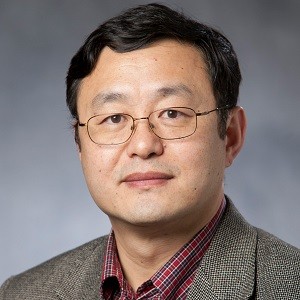 Jie Liu, George Barth Geller Distinguished Professor of Chemistry, Trinity College of Arts & Sciences, Duke University
Prof Liu’s research interests are focusing on the chemistry and material science of nanoscale materials. Specific topics in his current research program include: Self-assembly of nanostructures; Preparation and chemical functionalization of single walled carbon nanotubes; Developing carbon nanotube based chemical and biological sensors; SPM based fabrication and modification of functional nanostructures.
 Steve Nowicki, Professor Emeritus of Biology, Trinity College of Arts & Sciences, Duke University
His lab studies animal communication, asking both proximate and ultimate questions about how signaling systems function and how they evolve. Most of their work is done with birds, although lab members have studied a variety of other taxa. One major theme that runs through their work is to understand how signal reliability (“honesty”) is maintained in the face of the competing evolutionary interests of signal senders and receivers. They use both laboratory experiments and field-based analyses to test hypotheses about the costs of signal production, which theory suggests are necessary to maintain reliability. For example, they have demonstrated that the reliability of birdsong as a signal of quality in the context of mate choice is maintained by variation in the response of young birds to early developmental stress, which in turn affects brain development and song learning. Another theme that runs through their work concerns how animals themselves perceive signals, in particular the role of categorical perception in communication. Their work here began with birdsong, for example demonstrating context-dependent variation in category boundaries that define the smallest acoustic units of song (“notes”), and identifying categorical responses of neurons in the “song system” of the brain to variation in those notes. More recently, they have begun to study categorical perception in visual signaling, demonstrating for example that the carotenoid-based orange-red coloration commonly used in assessment signaling may be perceived categorically. This finding illustrates the connection between their interests in perception and reliability, given that canonical models of reliability assume continuous perception.
Thomas Nechyba , Professor of Economics, Trinity College of Arts & Sciences, Duke University
Prof Nechyba conducts his research within the fields of public finance, fiscal federalism, and the economics of education. His studies tend toward the investigation of function within local governments, public policy issues concerning disadvantaged families, and the economics behind primary and secondary education. He received funding for one of his latest projects, “An Empirical Investigation of Peer Effects in Schools and of Household Responses to School Policy Changes,” from a National Science Foundation grant. He also received support from the Lincoln Institute for Land Policy for his work, “Urban Sprawl;” from the Spencer Foundation for his study on, “The Role of Peers, Parental Choices, and Neighborhoods;” from the New Zealand Ministry of Education for a study on, “The Impact of Family and Community Resources on Education Outcomes;” and the Hoover Institution for the study, “The Implications of New Federalism.” He also received monetary support from the National Academy of Sciences for his investigation of the fiscal impact of immigrants, and from the Center for Economic Policy Research for various projects concerning education and welfare policy. In addition to his individual research pursuits, Prof Nechyba is also a Research Associate at the National Bureau of Economic Research.
 Victoria Szabo, Research Professor of Art, Art History, & Visual Studies, Trinity College of Arts & Sciences, Duke University
Prof Szabo’s primary teaching and research interests are in the intersection of digital humanities and computational media. Her current projects focus on archives-driven, extended reality (XR) experiences in urban, exurban, and exhibition contexts, with ongoing attention to location-based augmented reality (AR), digital storytelling, and artificial intelligence (AI) in cultural heritage and media arts. Prof Szabo is the Director of Graduate Studies for the Computational Media, Arts & Cultures PhD and of the Information Science + Studies Graduate Certificate and Lab. She is also a core member of the Digital Art History & Visual Culture Research Lab at Duke, and of the international Visualizing Cities collaborative. She is the co-Director of the Duke-DKU Presence Lab, currently supported by the The Institute for Global Higher Education at DKU and Duke Bass Connections.
Recent collaborative digital projects include Digital Durham, NC Jukebox (NC mountain music), Ghett/App (architectural history of the Venetian Ghetto), A Worthy Place: Duke, Durham, and the World of the 1920s-30s, and Virtual Black Charlotte, in collaboration with Johnson C Smith University. A new project, Visualizing Lovecraft’s Providence, explores the multimodal digital remediation of fictive places and spaces as a form of literary adaptation. Prof Szabo also co-creates video game based art installations with Psychasthenia Studio, and engages in digital arts curation and exhibition projects within the digital arts community at ACM SIGGRAPH, where she is currently Chair of the Art Advisory Group and a member of the Digital Arts Community Committee.